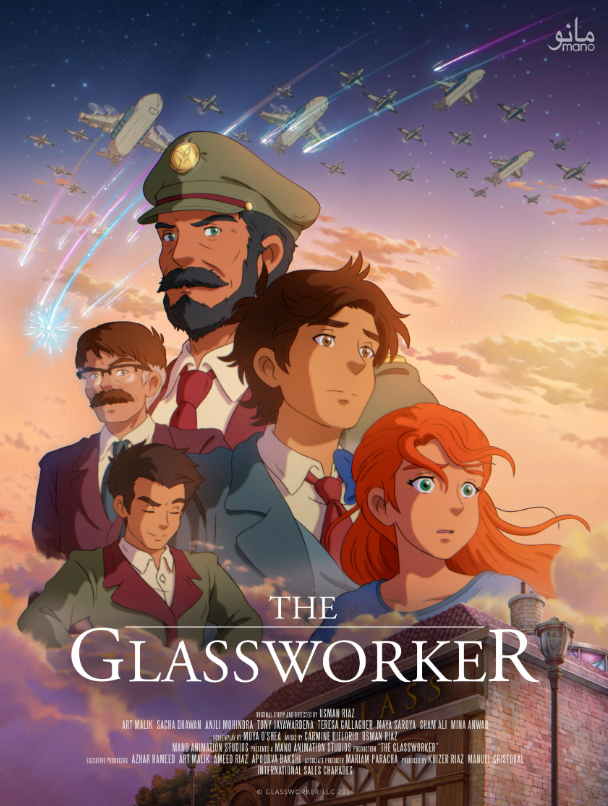
Coming from Mano Animation Studios in Pakistan, “The Glassworker” is a traditionally-animated film featuring poignant anti-war themes, contemplating the nature of art, and demonstrating the human experience in the midst of adversity.
Originally released in 2024, “The Glassworker” made its debut to American audiences in August 2025. Taking inspiration from Studio Ghibli, Mano Animation Studios has produced nothing short of an animated masterpiece, integrating Pakistani culture into its visual style. While “The Glassworker” is inspired by Ghibli films, it sets itself apart by covering themes relevant to Pakistan today that can be enjoyed and reflected upon by anyone, regardless of national origin.
“The Glassworker” covers difficult subjects common to Hayao Miyazaki’s works. The film takes place in a world that mirrors our present reality to an uncomfortable degree, but does not take place in said reality. While the design of trains, streetcars, fighter planes and bombers may vary in their fantastical nature, it is easy for the viewer to bring comparisons to real world difficulties, past and present. An unnamed war over a mineral rich ravine serves as the backdrop of the entire film. “The War” is brought up repeatedly throughout the film, though never seen directly until the end. Instead, the film focuses on how it affects the lives of ordinary people. While many young men towards the start of the film eagerly sign up in a wave of patriotism, it is the older generation who realizes the bloody end result that must follow.
A Story of Art and Music
The film follows its dual protagonists, Vincent Oliver and Aliz Amano. Vincent and Aliz’s characterizations, friendship, and later doomed romance, serve as physical manifestations of the film’s themes and narrative.
When the two first met as children, neither of them knew of each other’s backgrounds, nor did it matter to either of them. It did not matter to them that one’s father was a staunch pacifist, whereas the other was a decorated colonel.
When Aliz first arrives in the picturesque seaside town of Waterfront, she meets Vincent, a native to the area. Aliz is attracted to the glassworks and enraptured by the beauty of Oliver’s father’s creations. After saving young Vincent from shattering a newly completed piece in a chance meeting, she later befriends him. Vincent later takes her to a beach behind the glassworks and explains why the beach remains largely untouched, despite the urban sprawl above. Folklore and fantasy meet disbelief and intrigue. As the film progresses, the pair’s lives proceed in different directions. Vincent remains homeschooled, prepared by his father to take over the family business. Aliz attends the prestigious academy, being prepared for a long and fruitful career in music. One seems destined to remain a common craftsman, the other to perform in high society. The simple, but fulfilling life led by Vincent contrasts the more hectic social circles Aliz finds herself in. The two are unified by their respective fathers’ efforts to shield them from the brutality of the ongoing conflict, despite their radically opposed political views. Their friendship was one born not out of arrangement or even commonality. By all means, the two seemingly should have never been able to meet. Despite that however, the film demonstrates the purity and closeness of their bond. Regardless of one’s position in life, it is still possible to find friendship in the most unexpected of places, with the most unlikely of people, if it is given a chance to bloom.
Conflict arises in the middle of the film when Colonel Amano confronts Tomas Oliver, Vincent’s father, in a secret meeting. Threatened with conscription, Colonel Amano forces Tomas to retrofit his workshop. Overnight the workshop is turned into a covert manufacturing plant for specialized equipment only a skilled craftsman like Oliver can produce. With the war escalating, Amano justifies his actions to Oliver by saying it is for the good of the nation, despite Oliver’s protests as a pacifist. Amano’s coercion of Oliver serves as a major plot point for the film, later contributing to Vincent’s declining mental state as he enters teenage life.
By transforming the glassworks into a covert manufacturing plant, the audience is shown how war corrupts all that it touches. Like a rot, the corruption spreads into not just the hearts and minds of loving fathers, but even art and life itself. A sanctuary once dedicated to the birth of art was quickly disfigured into a dealer of death. Tools once meant for the manufacture of beauty, now serve to help fuel the war engine. Hands which once crafted artwork, instead now build wicked devices to further a pointless confict. No child cares, much less can comprehend, the nature of war and global conflict. The only thing that a child understands about war is how it affects them. It robs families of fathers, brothers, mothers and sisters, consumes life, and corrupts all that it touches. To a child, a war does not give anything. It only takes.
To the film’s fault however, like many of Studio Ghibli’s films, “The Glassworker” has a confusing ending that may leave audiences bewildered. However, the nature of the ending itself serves as food for thought. While some may find it a point of confusion and perplexing ending to the film, it can also serve as an opportunity to contemplate the questions the film raises. It is a silent, albeit mystifying, introspection on the fragility of human life, much like glass art.
Art, Imitation, and Inspiration
One moment around three-fourths into the film, easily overlooked, stands out upon further inspection. After narrowly surviving a bombing raid, Aliz and Vincent have an argument. During the moment, Vincent makes a curious statement. He acknowledges Aliz’s incredible skill as a musician, but accuses her of only being able to copy. He declares that she will never be an artist. All that she can do is repeat what others have done, whereas everything he does is original. Aliz, offended and resolute, later pours her heart and soul into composing a special piece.
There has been discourse surrounding “The Glassworker” and how closely it emulates the Ghibli style to a fault. While there is some truth to this, all art builds off inspiration of what came before. Whether it be the beauty of nature or things crafted by mankind, we stand upon the shoulders of what came before us. One can take inspiration from something, even emulate it, but still tell their own original tale with it. Mano Animation Studios are far from the first organization to be inspired by Hayao Miyazaki and Studio Ghibli.
Simply put, if Mano Animation Studios was in this as merely a cheap Studio Ghibli imitator, it is the opinion of the author that they would not have subjected themselves through the troubled development cycle that this film endured. If they were in this to make a profit, they would not have set out on such a lengthy endeavor. While there are moments throughout when the film suffers in varying animation quality, it never descends into being subpar. “The Glassworker” has established itself as a bold, though perhaps overambitious at times, opener for the nascent animation studio.
A supplementary documentary series from Mano Animation Studios provides further insight. Founder and Director Uzman Riaz states, “Pakistan is known for many things, but hand-drawn animation is certainly not one of them.” Riaz goes on to explain in detail the difficulty of simultaneously developing the film, while building the necessary animation infrastructure in a country without any of it. In an era polluted by cheap, soulless animation and the threat of generative AI, Mano Animation Studios has opted for a breath of fresh air. While Mano Animation Studios has chosen to emulate tried and tested traditional art styles of its predecessors, it would be innovative to see animation styles drawing influence from Pakistani art and culture. One of the benefits of animation is that it is not constrained by the conventions of reality. In future works, this would work to further distance themselves from their inspirations, while keeping themselves visually distinct.
While perhaps Ghibli comparisons are inevitable, Mano Animation Studios tastefully infuses a touch of Pakistani culture in a positive light, opting to praise craftsmanship and beauty in the world. “The Glassworker” is filled with many such quiet scenes throughout the film. Prominently displayed are views of marketplaces filled with vendors serving steaming gualab jamun with cups of chai, ready to make the audience salivate. Patrons dressed in flowing colorful attire wander the stalls in view of the camera. Wide sweeping shots of the relatively untouched Waterfront town demonstrate its natural beauty, with its later fracturing under the strain of war. Still shots of peaceful interior moments inside the glassworks contrast the hustle and bustle of the academy. All this to show a shared human experience, regardless of where we may be from societally or geographically.
Perhaps for those reasons, among others, is why Studio Ghibli’s films have been met with such universal acclaim. These themes and ideas, while perhaps promulgated by Studio Ghibli, are not exclusive to them. By combining the beauty of nature with the mundanity of the human experience universal to us all, through the medium of animation, one can resonate with the hearts and minds of many. Tales like these are fantastical ones full of magic, contrasted by the harshness of the reality built around it. It is unafraid to show both faces of humanity, mankind’s capacity for creation and destruction. We see mankind’s propensity for love and hatred laid bare. Surrounding it all is the idea that mankind, despite its follies, can become something more. Mano Animation Studios, much like Studio Ghibli, takes these themes while incorporating parts of its own native culture into its creations.
In conclusion, as we live today with our own struggles, whether it be learning a new song, creating art, or merely trying to survive, “The Glassworker” serves as a commentary on how beauty can still arise in the midst of misery. It is a film with a soul and a heart as clear as glass, despite the murkiness of the hard subjects addressed.
___
For more information or news tips, or if you see an error in this story or have any compliments or concerns, contact [email protected]