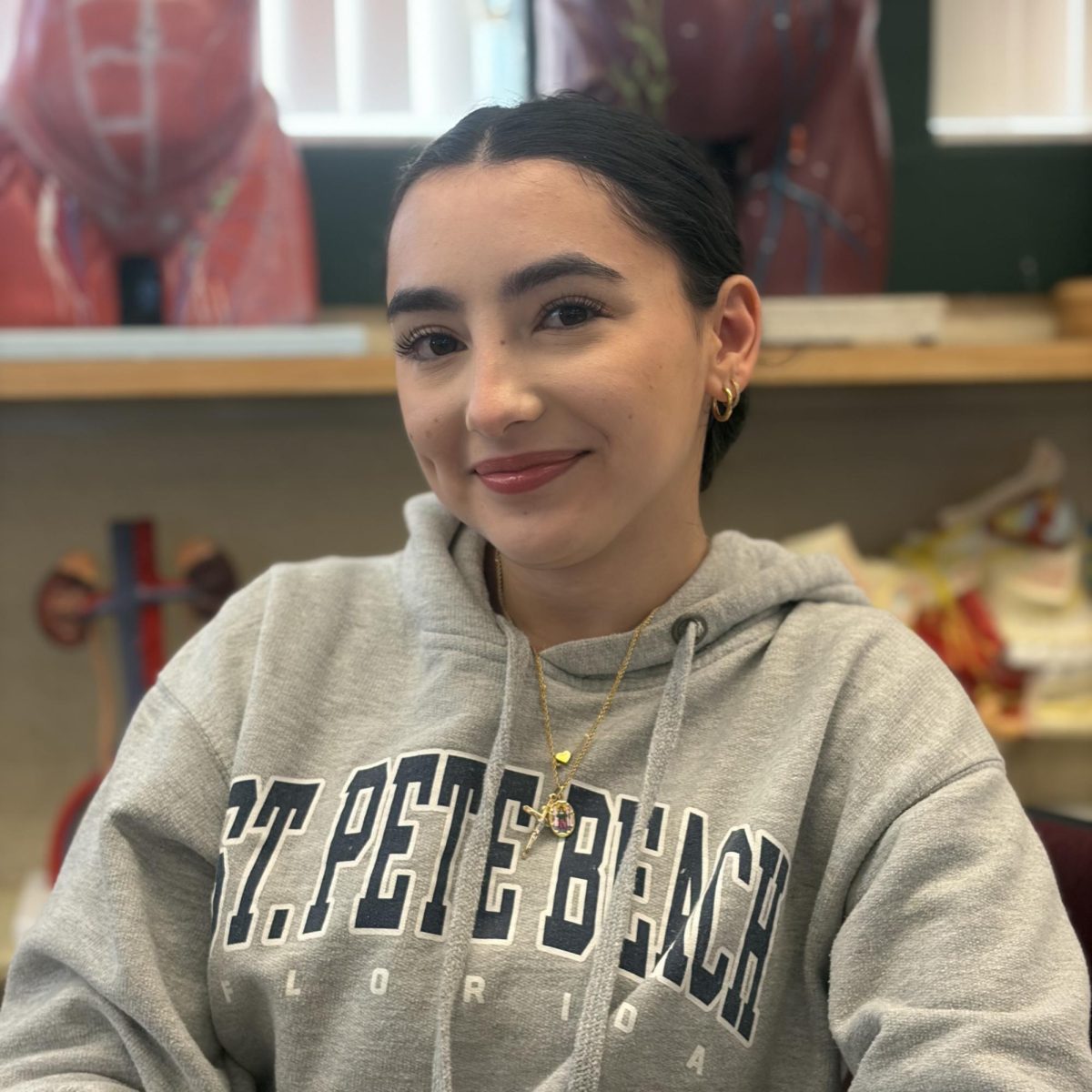
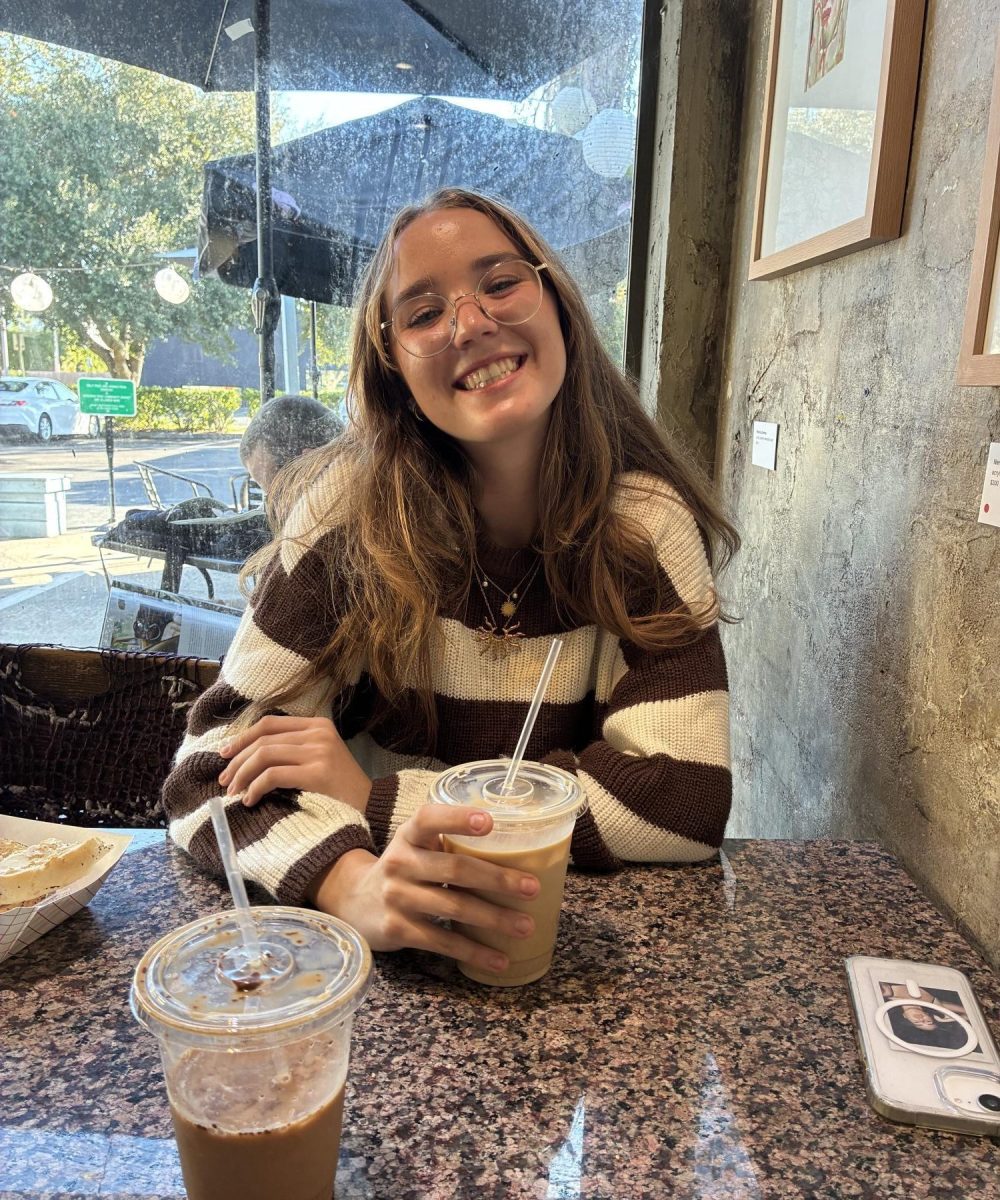
In this student spotlight, Jayna Hutchinson speaks about her aspirations of majoring in literature, her thoughts about AI, and her reflections on the literature she has read.
Majoring in Literature
Jayna is currently a senior in high school, alongside being dual-enrolled at LSSC. She is completing her Associate of Arts degree under general studies, but would like to major in literature and get a minor in French once she transfers to a university.
“Right now, I’m just doing the associate’s degree, just the general one. When I do eventually go into a university, I’ll probably be majoring in literature with a minor in French.”
Jayna explained that she desires to learn another language in order to enhance her brain’s cognitive abilities. She specifically chose French due to her inability to “roll her r’s.”
“I want to learn another language while I’m young to help my brain learn, and it would be really fun to be bilingual…I can’t roll my r’s, so I can’t do Spanish.”
Jayna hopes that majoring in literature will help her enter the book publishing industry. However, as a backup plan, she would like to become an educator.
“I’m hoping to go into publishing–just into whatever they have–because it’s a really competitive area. So, I’m hoping that it [majoring in literature] will help me get a job there. If it doesn’t, then my backup would probably be [becoming] a professor or a teacher.”
Professor Green’s Intro to Literature Class
During LSSC’s Fall 2025 semester, Jayna took Professor Courtney Green’s hybrid Intro to Literature course. Since Professor Green’s course primarily focused on reading AI-themed literary narratives, Jayna shared her initial thoughts about AI, and if her thoughts had changed after completing Professor Green’s course.
“Before the class, my thoughts on AI have been all over the place. When it first got introduced, I didn’t really do a lot of research on it. I didn’t really use it because it wasn’t very trustworthy, but there are some helpful ways to incorporate AI into assignments that I would sometimes do. If I forgot a word that would go into a place, I would write the sentence and say ‘fill in the blank…’ I kind of ventured away from that [using AI] because of AI’s environmental impacts and the ethical concerns surrounding AI as well. I’d rather stay away from it, but I would say that there are some helpful ways that can incorporate it. Since taking that class, I think we [her classmates and Professor Green] have had a lot of good discussions on AI’s pros and cons. I think that Professor Green has a really good way of trying to take both sides [of AI] and being like, ‘AI can be bad because of this, but AI can also be helpful because of this.’ I’ve come to the conclusion that if you want to use AI, that’s fine. I usually don’t [use AI] because I prefer trying to think for myself as much as possible. But if you want to use AI in small ways, I think that’s fine. I think that when it comes to the over reliance on it, that’s when it gets bad.”
Jayna further elaborated that people should avoid using AI in art such as literature, since art is supposed to come from a human’s individual thinking and creativity respectively.
“The whole point of literature is [that] it’s supposed to be your creativity. If you need help, then you can talk to other people. But I think in general, you should probably stray away from AI when doing creative things like the arts.”
Out of all of the literary narratives read throughout Professor Green’s course, Jayna’s favorite was the anthology “I, Robot” by Isacc Asimov. She also revealed that the narrative’s theme about the possibility of AI surpassing humans stood out to her the most.
“‘I, Robot’ was probably my favorite of all the readings. It’s a collection of short stories, but it is telling a narrative that spans like years, and I think that’s really interesting. All of the short stories can be told individually, but [when they’re told] together, I think they just tell a much more compelling story. The overall theme that was probably my favorite…I think it would be the fact that the technology in the stories became so advanced that it eventually surpassed humans. I think that was a really good theme to focus on…I just think that it’s such an interesting topic to discuss because it’s a very real possibility–not now–but sometime far in the future, where AI could somehow surpass humans. What will we do then? What’s going to happen? I think that [‘Could AI surpass humans?’] is an interesting question to pose.”
Jayna stated that Professor Green’s in-class discussions have helped her with analyzing the literary narratives read in her course.
“It helps more when we’re in the class. The discussion posts are helpful, but when we’re in the class actually talking about this [the course’s literary narratives], there’s multiple people going off of each other. I think that’s the most helpful for analyzing because it just shows that the human mind can’t do a lot alone, but it’s helped and encouraged by other people. You’ll be talking about something and then someone else will go off of your point. Then, that [the person’s point] will remind you of something else that you want to talk about. I think that has been really helpful because some people will point out things that you didn’t even realize, and it can help you make new ideas, and just overall analyze the text better.”
Jayna’s Personal Reflection on Analyzing Literature
Throughout the interview, Jayna expressed her immense passion for reading. She explained why, and specifically highlighted her recent read-through of the book “The Kite Runner” by Khaled Hosseini.
“I enjoy reading because there’s so many books that offer complex ideas. There was one book that I recently read, it’s called ‘The Kite Runner.’ [It’s an] amazing book [and] I love it. It explored the emotional depths of relationships, especially those who are impacted by war. I think that reading helps you realize things that you don’t even realize are happening in the real world…I think that reading can really help you and be insightful. Even if you’re just reading a romance book, I still think it’s helpful in figuring out how to deal with relationships and [other] stuff. No matter what book you’re reading, there’s always something you can learn from it.”
Jayna does not solely read for entertainment purposes. She also reads to learn from or identify what messages the author is attempting to convey and teach in a literary narrative.
“What are the major themes? What does the author want me to learn from this and how can I apply that in my real life? That’s definitely a lot of what I do [when reading]. There are some days where I don’t want to read anything that’s really in depth and academic. I just want to read some cheesy romance novel, and that’s fine too. If that’s all you read, you do you.”
Jayna also believes that other forms of media and art such as films and music excel at incorporating themes in their own unique ways. She encourages others to be intentional, mindful, and conscious of the media that people consume.
“I think that each media has a different way of doing it [incorporating themes]. I don’t want to say that one specific media is better than the other ones because they’re kind of in their own category. With books, you’re able to get a lot more in depth about a character’s inner emotions and feelings. In a movie, you’re able to show how a person is actually doing things, how they’re reacting, and what their face looks like…I wouldn’t say that one is better than the other. I’d just say that they both can do a really good job at conveying the same themes. With music, that’s another avenue you can take because it kind of goes into poetry as well. Putting a nice beat on it [a musical piece] too can get people to enjoy it more and analyze it. I’ve seen on social media people going in depth on the meaning of one song and I’m like, ‘This is so crazy. If only we could do this for everything.’ I think that this healthy discussion about, ‘What’s the meaning of this?’ should be applied to every medium.”
Jayna mentioned Swifties (Taylor Swift’s fans) as an example of people analyzing the media they consume.
“Swifties will go in depth about her [Taylor Swift’s] lyrics. They’re actually so determined to figure out what she’s talking about. We should do that [critically analyze] for pretty much everything.”
When asked if she had a favorite book, Jayna initially said it was hard for her to decide which one to choose.
“It’s so hard to pick my favorite because [in] the same way that each media does a good job at portraying certain themes, each genre of book has its different way of telling a story. I’m not gonna compare something like ‘The Great Gatsby’ to whatever romance novel I’m reading because those are two different things. They were written in different times, and they’re written in different ways. I can pick which one I like more, but it’s just hard to pick my favorite because each genre of book has its own job, and I don’t want to say that one job is more important than the other.”
However, Jayna did share a couple of contenders for her potential number one favorite book. The first contender was Jane Austen’s “Pride and Prejudice.”
“I would say that my favorite ‘classic’ would probably be ‘Pride and Prejudice.’ [I] love that book. I think it’s amazing. I love overanalyzing it, and to this day it’s the only book that I’ve ever marked up…I actually went back, reread that book, and did it because there’s so many good themes that you’ll miss on your first read. Some people write it [‘Pride and Prejudice’] off as a romance novel, but I think it’s actually telling a really deeper story about the role of women in society, class differences, and stuff like that.”
The second was Madeline Miller’s “The Song of Achilles.”
“I’d say another one of my favorite books is ‘The Song of Achilles.’ It’s a retelling of the Trojan War from Patroclus’ perspective about Achilles. Achilles is one of the main characters, but he’s not the narrator. I thought that was really interesting–telling his story from the view of someone who loves him. I also really like Greek mythology.”
The third was Khaled Hosseini’s “The Kite Runner.”
“‘The Kite Runner’ actually devastated me. I cried for like twenty minutes after I finished reading it. It’s really sad, but it does tell an overarching narrative of [how] your actions have consequences, and sometimes you can’t always undo what you’ve done. You can’t go back to fixing your relationship because they’re gone, or you just can’t go visit them.”
The fourth was Adam Silvera’s “They Both Died at the End.”
“I was reading ‘They Both Died at the End,” which might be one of my favorite romance books. I was reading it on a plane and spoiler alert: they both died at the end. And when they did, I was sobbing on the airplane. I had to leave the terminal, and go where everyone else was. My eyes were puffy. There’s tears streaming down my cheeks. I like books that can make me cry.”
Finally, Jayna mentioned the “Percy Jackson & the Olympians” books by Rick Riordan.
“I would also say that there’s always going to be a special place in my heart for all the books that I loved when I was a little kid like Percy Jackson. [I’m a] big fan of Percy Jackson. But if I went and read it right now, it wouldn’t be up to par because it’s obviously written for children. But I’m still going to say that it’s one of my favorite books because it’s what got me into reading, and I do think that it has a lot of good themes about getting over what other people think are your disadvantages and using that to your advantage.”
Advice for Students
Jayna’s main advice for students is to talk with others on campus. She recommends communicating with other students to build friendships, alongside communicating with instructors to gain a better understanding of a course’s material.
“Talk to people, there’s so many people that I know that are like, ‘I haven’t made any new friends since I’ve been here.’ I think that’s such a waste. I think that if you’re in college, even if it’s a community college, you should use that to your advantage. Get yourself out there, make friends, and be [part of] a community because I think that not enough people do that especially. After 2020, with all the parasocial relationships, I think that people [have] lost a lot of social skills. We need to get that [social skills] back because people are just scared of talking to people now and introducing themselves. I think that’s such a shame because you’re missing out on a lot of good friendships and relationships that you could be having because you were too scared to talk to them.”
Jayna graduates from LSSC this semester. After graduating, she plans on attending a university to pursue a major in literature, alongside a minor in French.
___
For more information or news tips, or if you see an error in this story or have any compliments or concerns, contact [email protected]